

Professor Xiaoying Tang from Southern University of Science and Technology Visited APM
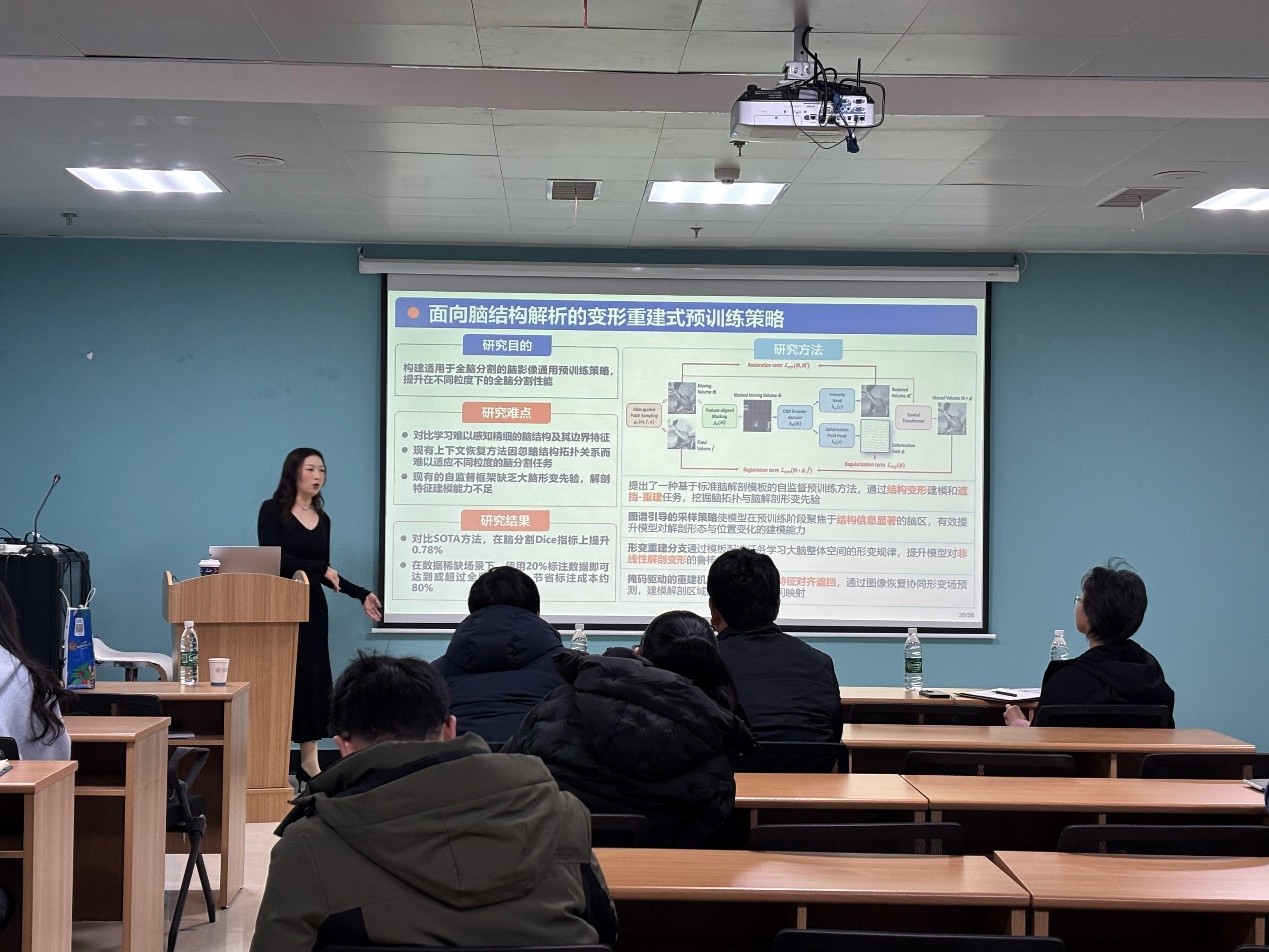
On December 5, 2025, Professor Xiaoying Tang from the Department of Electronic and Electrical Engineering at Southern University of Science and Technology was invited by the Ultrasensitive Magnetic Resonance Research Group to deliver an academic report titled "Full-Stack Intelligent Diagnosis and Treatment Technology Innovation for Eye-Brain Diseases Empowered by Medical Imaging" in Conference Room 1819. The seminar was chaired by Prof. Haidong Li.
Prof. Tang received her Ph.D. from Johns Hopkins University and is a recipient of the National Natural Science Fund of China for Outstanding Young Scholars. Her research focuses on intelligent medical-image computing and analysis, with applications in multimodal magnetic-resonance brain imaging, multimodal ophthalmic imaging, and AI-based early diagnosis and prognosis of brain and eye diseases. Over the past five years she has published more than 30 papers as corresponding author in leading journals and conferences such as IEEE Transactions on Medical Imaging, Medical Image Analysis, and ICCV, including eight in IEEE T-MI and three in MedIA; she also holds more than 10 granted Chinese invention patents.
In her talk Professor Tang first identified three core challenges facing current foundation models in medical imaging: poor quality of large-scale multimodal data, lack of fine-grained lesion localization, and difficulty in handling three-dimensional images. She then systematically introduced her team's "deformation-reconstruction pre-training strategy for brain-structure parsing." Using a standard brain anatomical template, the method builds self-supervised tasks of "structural deformation modeling–masking–reconstruction." An atlas-guided sampling strategy focuses pre-training on brain regions with salient structural information; a deformation-reconstruction branch learns the global non-linear deformation field through template-registration tasks; and a decoding-driven reconstruction mechanism implicitly maps anatomical regions by aligning masked regions. Finally, she demonstrated how this paradigm can be deployed across the full stack of intelligent diagnosis and treatment for eye-brain diseases, providing an efficient and interpretable imaging tool for personalized precision medicine.
After the lecture, Professor Tang engaged in lively discussions with faculty and students, deepening their understanding of AI-enabled precision diagnosis and treatment for ocular and cerebral disorders.
Innovation Academy for Precision Measurement Science and Technology, CAS.
West No.30 Xiao Hong Shan, Wuhan 430071 China
Tel:+86-27-8719-8631 Fax:+86-27-8719-9291
Email:hanyeqing@wipm.ac.cn
鄂ICP备15017570号-1
